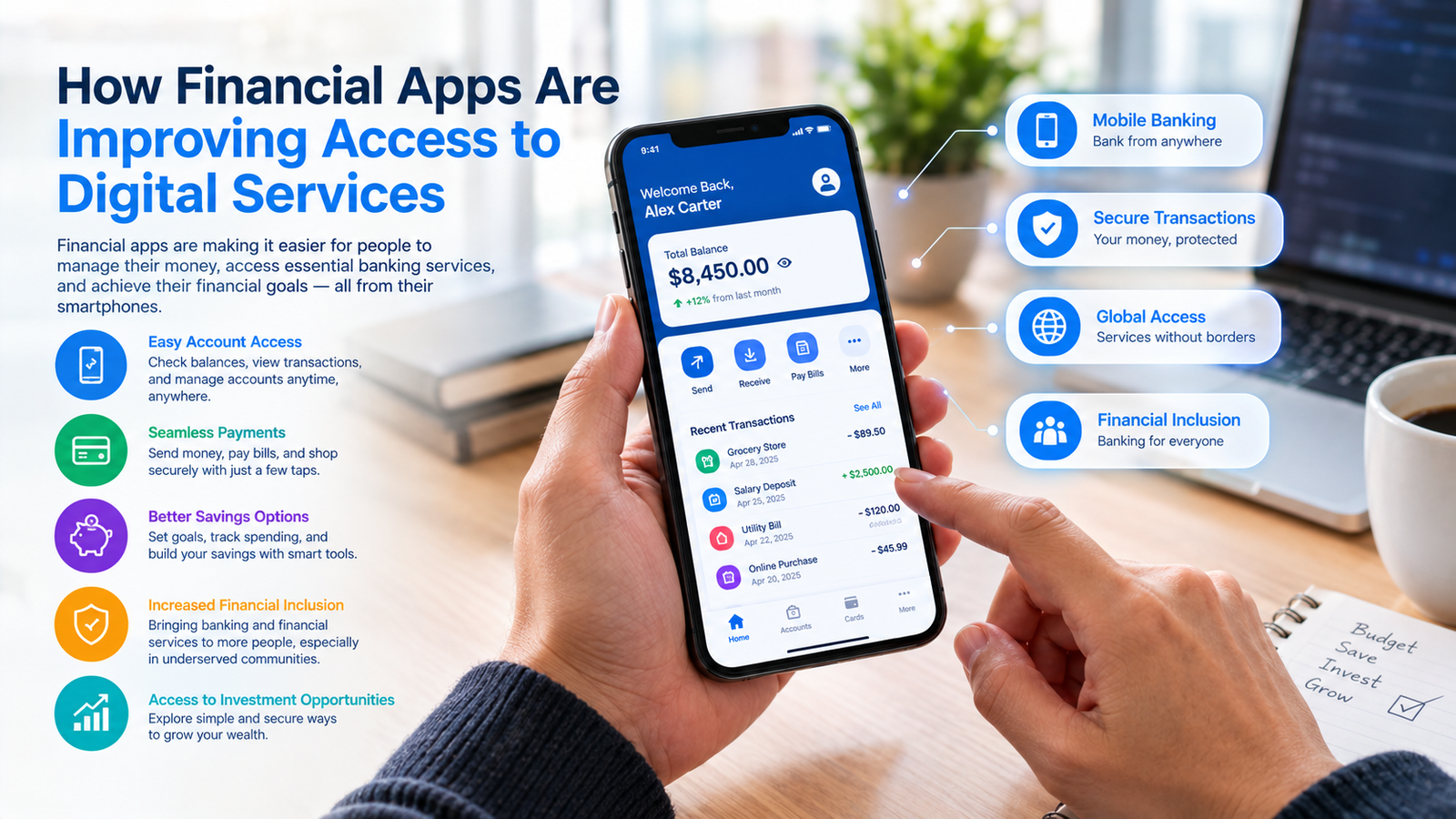
Roughly a billion adults worldwide still don’t have access to a traditional bank account, and for a long time that meant no access to savings tools, credit, or basic financial infrastructure at all. Mobile phones changed that math faster than any branch expansion ever could. A capable Financial app development company can reach someone in a rural area with no bank branch for a hundred miles just as easily as someone in a major city, and that shift is quietly reshaping who gets to participate in the financial system at all.
Access isn’t just about having an account, though. It’s about whether the tools actually work for the person using them someone with irregular income, someone who’s never had credit before, someone who doesn’t speak the dominant language of their country’s banking system. Here’s how financial apps are closing those gaps, and where the work is still unfinished.
Traditional banking required physical infrastructure branches, ATMs, staff that made sense in dense cities and made far less sense in rural or underserved areas where the customer base couldn’t justify the cost. Mobile-first banks and neobanks sidestepped that problem completely. All that’s needed is a smartphone and a data connection, which turns out to be a much lower bar to clear than building a physical branch network.
This has mattered enormously in regions like Sub-Saharan Africa and Southeast Asia, where mobile money services reached hundreds of millions of previously unbanked users faster than traditional banking infrastructure ever could have. The phone became the branch.
Conventional credit scoring relies on a credit history that a huge portion of the world’s population simply doesn’t have. No credit history usually meant no loan, regardless of someone’s actual ability to repay one. Financial apps built alternative scoring models using transaction history, mobile payment patterns, and even utility bill payments to assess creditworthiness for people the traditional system never evaluated at all.
This opened small loans to entrepreneurs, farmers, and gig workers who needed capital but had no paper trail a conventional bank would recognize. It’s not a perfect system, and alternative credit scoring carries its own risks and biases worth watching closely, but it’s meaningfully widened who gets considered for credit in the first place.
Sending money across borders used to mean high fees and multi-day waits, often through services that took a significant cut just for moving money from one country to another. Financial apps built around digital remittances cut both the cost and the time dramatically, sometimes reducing transfer fees by more than half compared to legacy services.
This matters enormously for migrant workers sending money home to support family, where every percentage point taken in fees is money that doesn’t reach the people who actually need it. Faster, cheaper remittances aren’t a minor convenience here they’re a direct increase in household income for millions of families.
An app built only for fluent readers of a dominant language quietly excludes a huge portion of a potential user base. Better financial apps now support multiple languages, voice guidance, and simplified visual interfaces that don’t assume high literacy or extensive smartphone experience. Icon-based navigation and audio instructions have made financial tools usable for people who’d otherwise be locked out by a text-heavy interface built with a narrow user in mind.
This kind of design work rarely gets attention, but it determines whether “financial inclusion” is a real outcome or just a marketing phrase attached to an app that only works for people who were already reasonably well served.
Not every user has consistent internet access, and an app that breaks completely without a stable connection fails exactly the population it’s often trying to serve. Some financial apps now support offline transactions through USSD codes or SMS-based systems, allowing basic banking functions on connectivity that would make a typical app unusable.
This might be the least glamorous engineering work in the entire fintech space, and it might also be the most important for actual access. A beautifully designed app that requires constant high-speed internet doesn’t help anyone living somewhere that connection isn’t reliable.
Opening a traditional bank account often required documentation many people simply didn’t have proof of address, government IDs tied to a fixed residence, paperwork that assumes a level of formal infrastructure not everyone has access to. Biometric verification, using fingerprints or facial recognition instead, has let financial apps onboard users who would have been rejected by document-heavy traditional processes.
This has been particularly significant for refugees, informal workers, and people in regions where formal documentation systems are limited or inconsistent, giving a path into the financial system that didn’t exist through conventional channels.
None of this happens without serious investment. Cost to Build a Fintech App varies enormously depending on scope, but products built for underserved markets often carry additional cost from things a typical fintech app doesn’t need offline functionality, multilingual support, alternative credit models, compliance across multiple regulatory jurisdictions at once. It’s a harder engineering problem than building a banking app for an already well-served urban market, and the cost reflects that complexity.
Access to a financial tool doesn’t automatically mean someone knows how to use it well. Recognizing this, a growing number of financial apps now bundle in budgeting guidance, savings goal tracking, and plain-language educational content directly into the product, rather than assuming users arrive already financially literate. This closes a gap that access alone never solved on its own having an account is only useful if someone also knows how to make it work for them.
Financial inclusion used to be measured mostly by how many people had a bank account at all. That bar has moved. Real access now means credit for people without a credit history, remittances that don’t eat a family’s income in fees, and interfaces that work regardless of language, literacy, or connectivity. Financial apps didn’t just digitize existing banking. They rebuilt who the system was designed to serve in the first place, and that shift is still very much in progress.